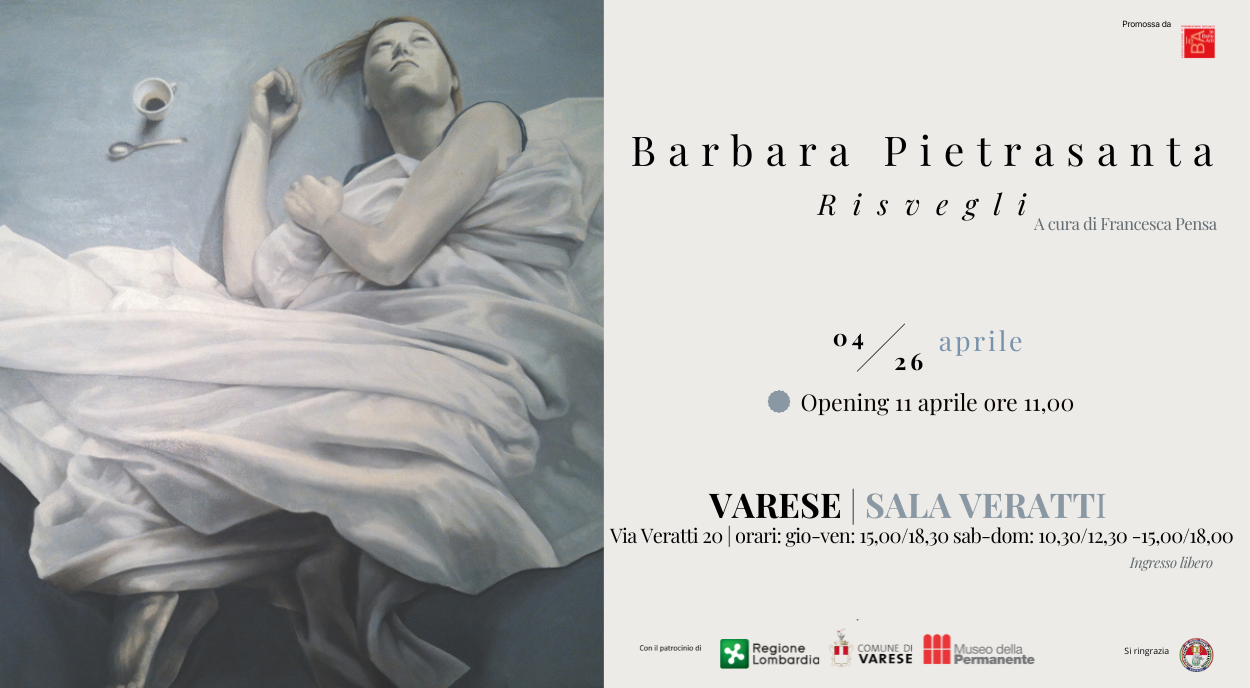
Barbara Pietrasanta “Risvegli”Awakenings
27/02/2026
Barbara Pietrasanta “Risvegli” Awakenings
Curated by: Francesca Pensa
4 – 26 April 2026 | Inauguration: Saturday, 11 April 2026 at 11:00 AM
Sala Veratti | via Veratti 20, Varese
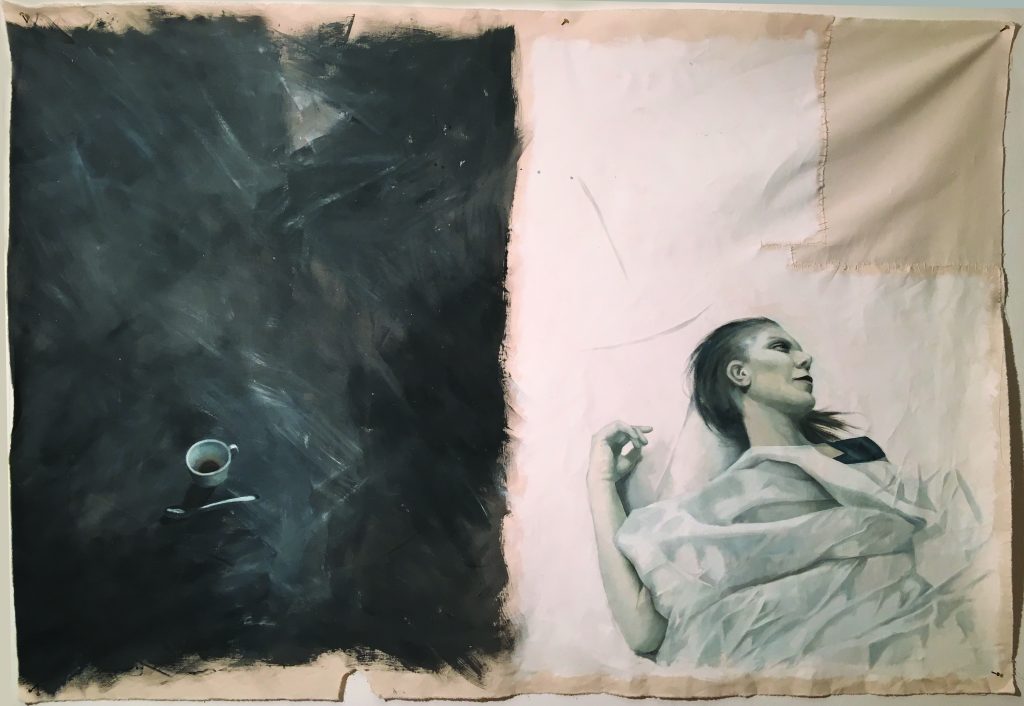
The exhibition Risvegli by artist Barbara Pietrasanta, hosted from April 4 to April 26 at the prestigious Sala Veratti in Varese and under the patronage of Regione Lombardia, the Municipality of Varese, and the Museo della Permanente in Milano, presents approximately 24 oil paintings centered on the theme of awakening as a suspended moment between the ecstatic world of night and the uncharted dominion of day.
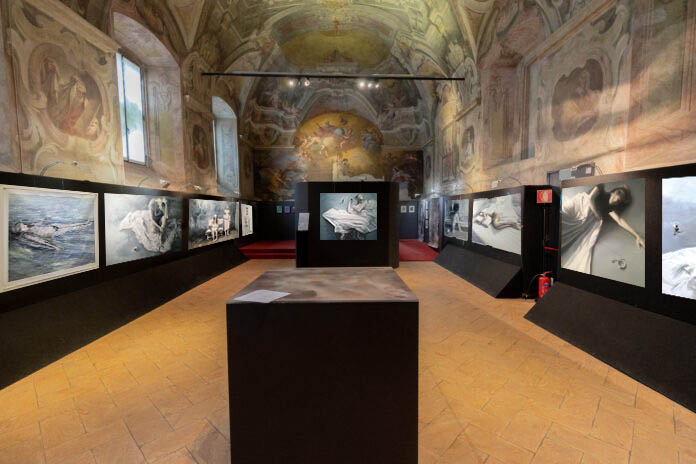
Visitors will be drawn into the canvases of Barbara Pietrasanta, which depict predominantly female figures wrapped in sheets as they wake from sleep, lying on monochrome floors, accompanied by the presence of a small coffee cup — an indispensable tonic easing them into the reality of the world. The soft colours and ecstatic poses reveal them as caught in the fleeting instant of the here and now, a condition that creates a strong emotional bond between the work and the viewer. The arrangement of these painted figures on the perimeter panels of Sala Veratti enables a visually striking dialogue between the contemporary figurative language of the artist’s work and the historic frescoes on the walls and vault of the room, together producing a particularly enveloping scenic effect.
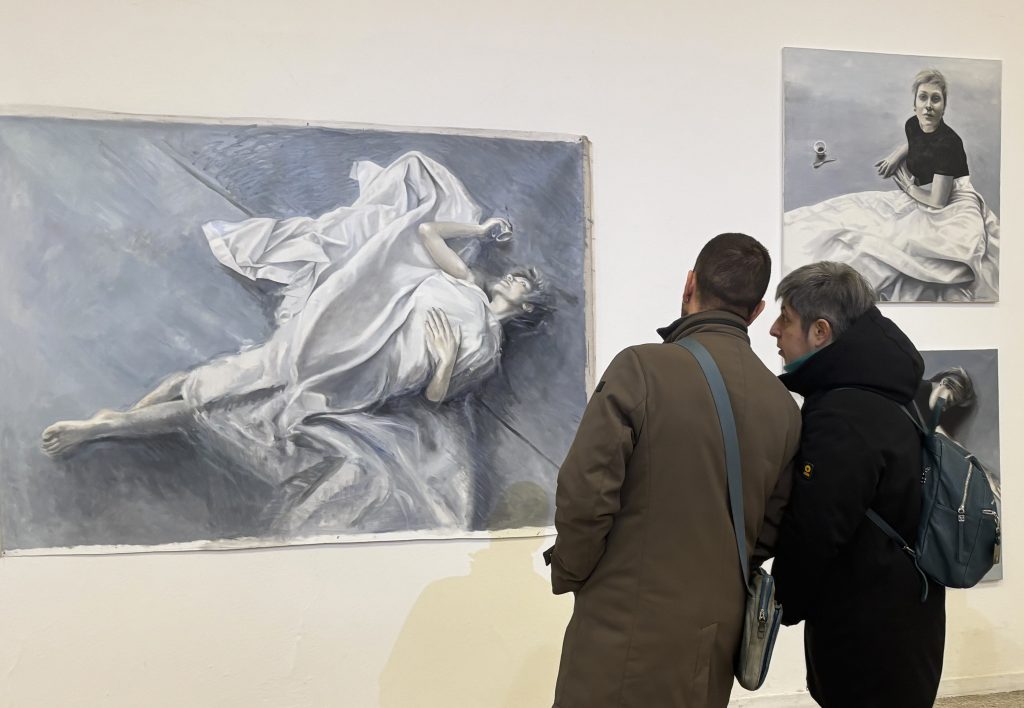
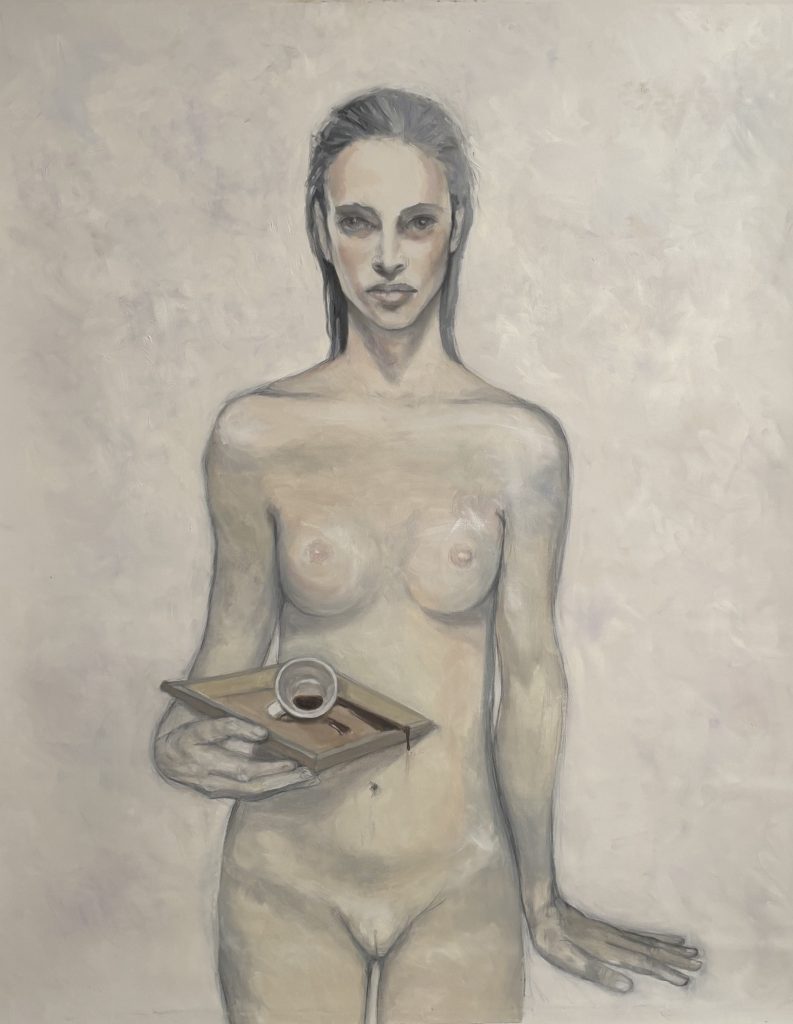
The Risvegli cycle, developed since the early 2010s, is interwoven throughout the exhibition with canvases from other cycles produced in recent years: those dedicated to the themes of water and shipwrecks, shown at the Acquario di Milano and the Museo Galata in Genoa, and those dedicated to climate change, shown recently at the Museo della Permanente in Milano. These are themes always approached with particular attention to the introspective and emotional dimension — the psychological mechanisms set in motion by the defining events of our time, such as the Pandemic, global warming, and war. Through the works on display, produced predominantly in recent years, Barbara Pietrasanta also touches — while remaining faithful to the fil rouge guiding the exhibition — on the broader themes of contemporary life: climate change, migration, social fragility, with a gaze that weaves together poetry, introspection, and social engagement.
Art historian Francesca Pensa writes of her:
From the 1990s onward, Barbara Pietrasanta’s expressive output began to appear in exhibitions — the first significant ones in her career — in which the creative form of her work, already decidedly mature, revealed its originality. The painting of that period, which embraced without hesitation a current and contemporary figuration, unfolds in images where compositional elements develop into a narrative whose interpretation remains open, while nonetheless guiding the viewer toward preferred — and in some cases recurring — themes.
Almost programmatic is the oil Strade, bivi e deviazioni (Roads, Crossroads and Detours), dated 1992, populated by figures of ambiguous gender identity; it finds an echo in Leslie and Gestazione, where the protagonists are men poised between the feminine and the masculine. In this phase of her poetics, reflection on questions of gender identity comes clearly to the fore — themes the artist had been able to explore during her stay in the United States, specifically in New York in the 1980s, when these subjects were actively debated in American culture but still rarely addressed in Italy. The dangers threatening our natural world disturb the transparent water of Petrolio, while the unstoppable flow of migration gives substance to Confini; allusions to defining historical events of our time run through paintings such as Oltre il muro — significantly dated 1990, immediately following the fall of the Berlin Wall — and Le gemelle, a work of 2001, the year of the attack on the Twin Towers.
The theme of the figure takes shape in the creation of bodies whose anatomical precision reveals carefully studied chiaroscuro — deployed not so much for realistic effect as for a poetic one. The faces, save in rare cases, are devoid of emotion or feeling, closed in tight mouths and open eyes that can meet the viewer’s gaze with an almost provocative directness. The settings, often suggested by the artist’s memory of her time in America, vary widely and tend toward perspectives inspired by urban spaces or anonymous corners of great metropolises, while the palette is broad, with colours that remain — especially in the monochrome passages that may punctuate the composition — in tonalities that heighten the mental and introspective character of the narrative.
(Read more)
Barbara Pietrasanta
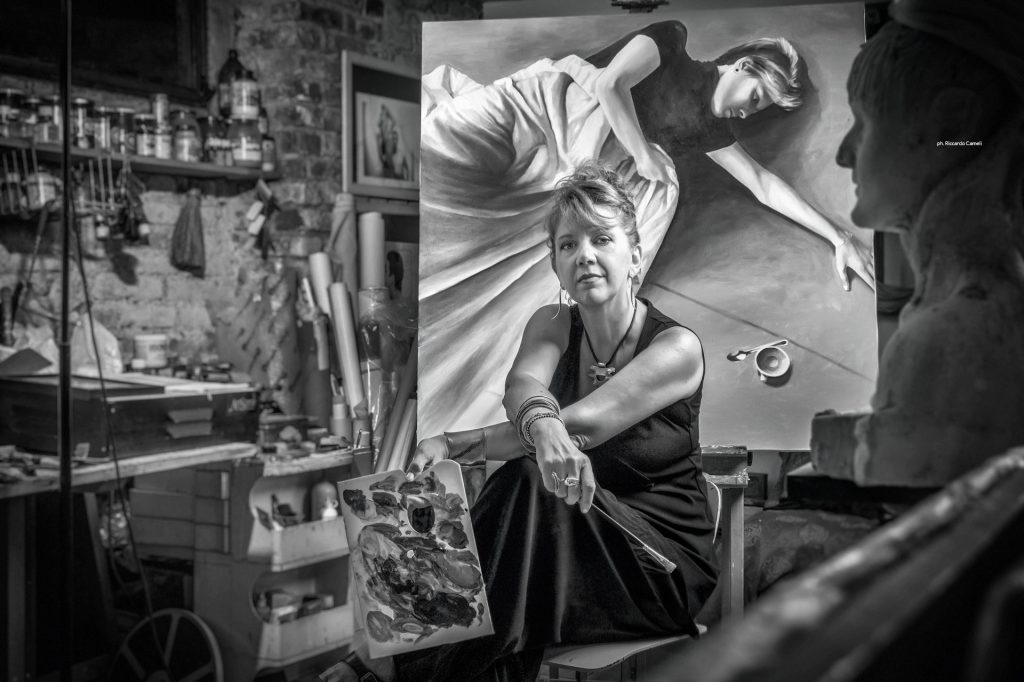
Milanese artist and designer, graduate of the Accademia di Belle Arti di Brera, she is Creative Director and co-founder of Anyway Comunicazione. She teaches Art Direction at IED and Communication Design at POLI.design, Politecnico di Milano. She is the author of the essay “L’ideogramma al neon. Comunicazione, pubblicità e lifestyle in Cina” (Lupetti), born out of her extensive teaching experience at Dong Hua University in Shanghai.
She has served as Vice President of the Fondazione Museo del Design at the Triennale di Milano, as a board member of the Fondazione A. Castiglioni, and on the board of the Museo della Permanente. She was appointed Ambassador for Italian Design by the Italian Ministry of Foreign Affairs and the Ministry of Cultural Heritage — in 2018 for Southern China and in 2017 for Egypt, also representing Italy at the XVI Settimana della Lingua Italiana in Cairo. She has been visiting professor at the University of Helwan and Ain-Shams University in Cairo, and at Xiamen University in China. She has represented Italy on the International Jury of the Global Design Award in Shenzhen, China.
She has exhibited in New York, San Francisco, Zagreb, Dubrovnik, Pula, New Delhi, Kolkata, Mumbai, Jaipur, Barcelona, Milan, Rome, Turin, and other Italian cities. Among her principal exhibitions: “Naufraghi e Naufragi” at the Acquario Civico di Milano and the Museo Galata in Genoa; “Cross Polynations” at the Teatro Dal Verme (Milan), Villa Ghirlanda (Cinisello Balsamo), Stendhal Gallery and Ambassador Gallery, Istituto Marconi (New York), Frank V. De Bellis Collection (San Francisco); Artissima (Turin); the Italian Cultural Institutes in New Delhi, Zagreb and Dubrovnik; Cvainer Gallery (Pula); Jaipur Museum (India); Visual Art Gallery and Arpana Gallery (Delhi); Habiart Art Centre (Kolkata). In New York she was invited by UNICEF to a programme dedicated to the protection of the planet.
She is the author of the fresco Via Crucis in the Chiesa Sacra Famiglia in Cinisello Balsamo and in the Parroquia Jesús Divino Maestro in Huacho, Peru. Her works are held in the Patrimonio della Provincia di Milano, in the Collezione Farnesina in Rome, and in the collection of the Museo della Permanente.