Francesca Pensa
10/02/2026
FiguFigures and Destinies: the Painting of Barbara Pietrasantare e destini: la pittura di Barbara Pietrasanta
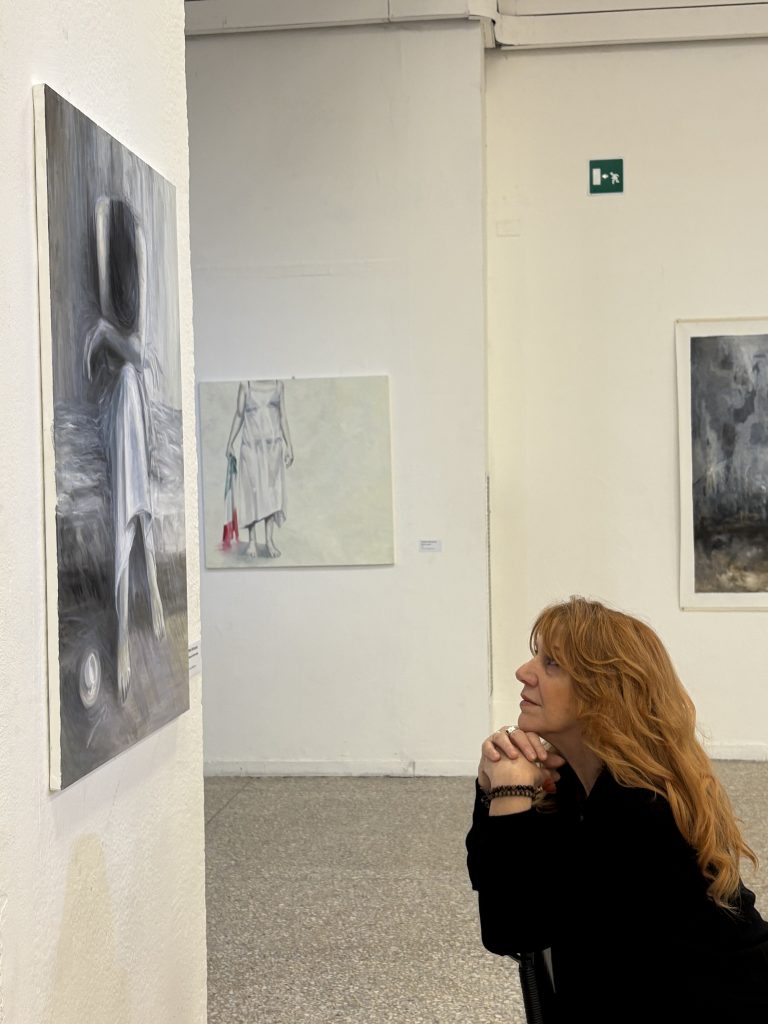
From the 1990s onward, Barbara Pietrasanta’s expressive output began to appear in exhibitions — the first significant ones in her career — in which the creative form of her work, already decidedly mature, revealed its originality. The painting of that period, which embraced without hesitation a current and contemporary figuration, unfolds in images where compositional elements develop into a narrative whose interpretation remains open, while nonetheless guiding the viewer toward preferred — and in some cases recurring — themes.
Almost programmatic is the oil Strade, bivi e deviazioni (Roads, Crossroads and Detours), dated 1992, populated by figures of ambiguous gender identity; it finds an echo in Leslie and Gestazione, where the protagonists are men poised between the feminine and the masculine. In this phase of her poetics, reflection on questions of gender identity comes clearly to the fore — themes the artist had been able to explore during her stay in the United States, specifically in New York in the 1980s, when these subjects were actively debated in American culture but still rarely addressed in Italy. The dangers threatening our natural world disturb the transparent water of Petrolio, while the unstoppable flow of migration gives substance to Confini; allusions to defining historical events of our time run through paintings such as Oltre il muro — significantly dated 1990, immediately following the fall of the Berlin Wall — and Le gemelle, a work of 2001, the year of the attack on the Twin Towers.
The theme of the figure takes shape in the creation of bodies whose anatomical precision reveals carefully studied chiaroscuro — deployed not so much for realistic effect as for a poetic one. The faces, save in rare cases, are devoid of emotion or feeling, closed in tight mouths and open eyes that can meet the viewer’s gaze with an almost provocative directness. The settings, often suggested by the artist’s memory of her time in America, vary widely and tend toward perspectives inspired by urban spaces or anonymous corners of great metropolises, while the palette is broad, with colours that remain — especially in the monochrome passages that may punctuate the composition — in tonalities that heighten the mental and introspective character of the narrative.
In some of these works the narrative may fracture into different fragments, as in Riscatto, or unfold in separate sections, as in Rivelazioni; but in general the scene is singular, concentrated on a single visual episode that nonetheless presents many facets. This is the case in the significant Il gioco della vita of 1992: on the green baize of a billiard table, the hands of invisible figures take aim at a ball with a cue and hold the pieces of a domino game, while a woman rests her head on her folded arms in the lower part of the scene, confined there by two dark, looming feet. What is the story? Impossible and pointless to establish with precision — other than by evoking the sometimes mysterious role that destiny plays in our lives, exposed, as in a game, to the chance of unforeseeable events.
With the new millennium, Pietrasanta’s art turns toward a painting that, while building on earlier experience, takes on new themes in a coherent development of her expressive means. From the second decade of the 2000s to the present, the poetic discourse shifts to a specific subject: water — a theme that has always been treated consistently throughout the history of art, as one might easily imagine for the element upon which all life depends. Barbara’s painting thus takes its place in a long red thread running through centuries of artistic history, in which water has assumed both positive and negative values, exemplified most clearly in the age-old iconographies of Christian baptism and the universal flood.
In the water stands the woman of Blu profondo and the modern Aphrodite of Anadiomede, in a liquid embrace that endows the setting with a vital and almost cathartic evocative power. But very different is the story of the figures in other works, in which water seems to assume a negative and perilous valence — the cause of destructive and terrifying shipwrecks. As Pietrasanta herself has noted, programmatically central to this cycle is a 2014 oil entitled Deposizione, in which water is only evoked — as an agent of death for the prone body, half-visible beneath a sheet. A tag, like those attached to bodies in a morgue, identifies the figure as one of the victims drowned in the Lampedusa tragedy. If the image thus reflects the memory of the age-old iconography of the Deposition of Christ, that single detail renders it absolutely contemporary, adding to the shipwrecks of these works a precise historical reference.
The figures depicted may appear alone, but of particular interest is the dual presence of female figures that characterises other works in this cycle. Observed carefully, one notices that the two women represented are always the same: one with short fair hair, the other, younger, with long dark hair. They wear similar garments — white, light, and translucent dresses that allow glimpses of black undergarments — and seem to have been caught by something inescapable, like a shipwreck, at a personal and intimate moment. They stand side by side — one seated, one standing — in Come dopo il naufragio (As After the Shipwreck), a canvas of 2019, each holding the loops of a rope that binds them in a bond that may have been the means of their survival at sea and that endures visibly even afterward. Each viewer may imagine the nature of the relationship between the two women — perhaps friendship, perhaps kinship, as between sisters or even mother and daughter — but this is not what matters: what united them was the water, and the upheaval it unleashed.
In the poetic dimension, the shipwreck evoked in these paintings ultimately loses its specific, literal quality, becoming a metaphor for more general situations that we too may have lived through in our own lives, in the face of unexpected events. And singular, in this sense, is the exhibiting history of this cycle of works — a history that enriches them with further meaning, perhaps even beyond Pietrasanta’s own original intentions. In 2021, everything was ready for a planned exhibition of these works at the Acquario Civico di Milano; but Covid prevented this from happening, except in a reduced form and later than originally scheduled. And what, if not Covid, more closely resembles a modern, collective shipwreck? Then, all of us — like the figures in these paintings — experienced the disorientation that follows an unthinkable event. All of us were left powerless and frightened before the collapse of many of our certainties, brought about by a global pandemic that had until then been unimaginable. And yet the two survivors — the fair-haired and the dark-haired — survived, as we did after the Covid years: there is hope, after the fear.
Also from the 2010s, Pietrasanta initiated the Risvegli cycle, which continues to the present: the canvases — not small in size — present female figures in the act of waking from sleep, wrapped in sheets shadowed by uncertain light, lying on monochrome floors and accompanied by the presence of a small coffee cup with its teaspoon. The works thus describe the instant of the passage from sleep to wakefulness, with all the implications this carries in the transition from the dream world — where the most unspeakable and fantastic desires unfold — to the reality of the world, with all its tangible and demanding situations. Female figures move through this moment and experience it in always different ways: half-asleep, eyes barely open (Svegliati); or awake but caught in the postures of sleep (Ora e non prima, Awakening); or already fully present, seated amid the folds of the sheets (Nel lenzuolo bianco, Turbamento, Domani è un altro giorno, Qualcosa ho dovuto lasciare).
Beside them is always the small coffee cup that wakes us and accompanies us as an indispensable tonic into the reality of the world. But the coffee cup is also the object in which one has often looked for a foretelling of the future: those women seem to be asking themselves what their own destiny will be — in the day just beginning, but also in the future dimension of the existence awaiting them. This is what the awakened figure of Il vuoto è nulla (2019) does with unmistakeable clarity. The coffee cup is thus, in these image-narratives, no secondary detail — as works specifically devoted to it, such as Nell’ombra and Satori, make clear. The theme widens further, no longer confined to the simple observation of a moment of everyday life that we all experience daily, but becoming a narrative of how we face the future with our fears and hopes. The protagonists of this cycle are women and young girls, who add an autobiographical tone to the final result — in the distinctly feminine sensitivity of looking inward — while depicting a situation that manages to become universal.
A significant variation on this theme appears in one of the most recent paintings Pietrasanta produced in 2024, Sogno d’inverno (Winter Dream), in which beside the sleeping figure there lies, across the brightness of the bed, the shadow of a bare tree — a natural element that opens the iconography of these works to a new dimension.
The expressive approach engages, as in the works from the new millennium onward, with visual narrative in a purely pictorial mode — that is, without interruption or fragmentation such as text insertions — and thus in a unified treatment of the theme, which unfolds without the slightest digression in its poetic synthesis. The figures are those typical of all of Pietrasanta’s art, to which is added a carefully studied rendering of the enveloping sheets that allow glimpses of the anatomies of concealed nudes — a modern and original use of the age-old theme of drapery.
The chromatic palette is defined by homogeneous, never vivid colours, arranged in a carefully studied tonality — tilting toward blues, greys, and whites — that create intimate and pervading atmospheres capable of almost entirely submerging the figure, as in the recent oil Perturbamento.
The mark that constructs the composition remains faithful to that already widely practiced by the artist in the building of images whose visual result always shows a personal interpretation of real-world inspiration; but Barbara does not forgo works in which expressive intention reveals a mark generated by a deeper and more urgent inner state. This occurs in the tense, restless figure of Fragments of Awakening and even more so in Trascurabili frammenti (Negligible Fragments), an oil played on the counterpoint of whites and blacks. It seems no coincidence that both titles speak of fragments — as if that broken mark better defines a fragment, brief yet charged with feeling, of existence.
It is interesting, and I would say inevitable, to situate this painting within comparisons that help illuminate its meaning by extending it into a historical perspective. The depiction of the sleeping woman is very ancient and has been explored by artists since the most remote times, when it took the celebrated form of Ariadne sleeping — abandoned on the island of Naxos by Theseus, who took advantage of her catatonic slumber. A canonical example of this archaic iconography is the celebrated sculpture preserved in the Vatican Museums, in which the semi-recumbent body reveals the complete unconsciousness of the sleeping figure.
But many women also sleep in more recent times, beginning with the Venus in an illustration from the Hypnerotomachia Poliphili — a supremely refined text printed in Venice in the fifteenth century — an image that is likely the root of the many female figures immersed in sleep and depicted, from the quattrocento onward, in so many celebrated works: those of Giorgione, Titian, Poussin, Füssli, Courbet, Delvaux, Picasso. In these representations of sleeping women across the history of art, what appears decisive is invariably the sleep itself — deep and paralysing, rendering the depicted women defenceless, as shown by the already cited Venus of the Hypnerotomachia, accompanied by a menacing ithyphallic faun, and as seen in Füssli’s celebrated The Nightmare, where the protagonist is loomed over by frightening, terrifying monsters. In Barbara’s works, the figures enact a significant transformation of this ancient iconography: the women are waking from sleep — and it is not difficult to read a historical meaning into this awakening, as a metaphor for the contemporary condition of women.
The conclusion of this journey seems to me identifiable in the nude of Aftercut — a recent work and something close to a final chapter of this story told in images. In the painting, the young woman appears decisively upright, standing while looking the viewer directly in the eye; she holds a tray with a small coffee cup that has perhaps tipped over in the act of rising — but which, in spilling without the coffee having been drunk, may underline the protagonist’s awareness of waking by herself, without help of any kind. A woman who is autonomous, as may also be read in two other paintings by the artist in which the female figure is accompanied by a bird — always felt and understood as a symbol of freedom. This occurs in Visione taumascopica, where a colourful parrot appears, and in the recent Annunciazione, la promessa sospesa (Annunciation, the Suspended Promise), in which a Palestine sunbird alludes to events from our most urgent and dramatic current reality.
The painting of Barbara Pietrasanta thus reveals an indisputable originality that, precisely by virtue of its quality, cannot fail to carry within it connections and references to other expressive situations — past and present. First to be considered is the choice of figuration, evident throughout the artist’s entire output: a choice of field whose defining term is clarified only when pursued to its depths, in its semantic and above all historical meaning. By figuration we mean specifically a mode of art that represents — with variants ranging from photographic reproduction to the barest reminiscence — the reality of people and their world.
Beyond the assessments made in times fortunately now past — which classified this creative orientation and its opposite, abstraction, in positive or negative terms — what appears entirely clear today is the extraordinary vitality of figuration (as an exhibition of some years ago was entitled), which has crossed the century of the avant-gardes undaunted, arriving in full health to the present. Among the periods of the twentieth century that saw the pre-eminence of artistic forms more closely connected to real-world inspiration are the 1980s, when the atmosphere of the Transavanguardia superseded the Neo-avant-gardes of the immediately preceding phase. This is, not by coincidence, the moment at which Barbara makes her appearance on the art scene — arriving there with a canonical formation, acquired at the Liceo Artistico and at the Accademia through the practice of drawing and the search for her own originality within a sensibility cultivated in dialogue with the history of images past and present. It is significant that her teacher at the Liceo di Brera was Mimmo Paladino — a leading protagonist of that expressive season — whose art would nonetheless constitute, as would that of other teachers encountered along the way (Alberto Ghinzani, Maurizio Giannotti, Antonio Miano, Fernando Sambati), a distant background, deeply sedimentated in the painter’s visual memory.
Regarding her American period — lived by Pietrasanta in the 1980s — critics have cited as possible influences artists such as Alex Katz and Philip Pearlstein. But beyond that phase of art, which saw, in the complexity of its results, the final season of Warhol and the rise of artists such as Basquiat (who do not appear to have greatly interested our artist), it is the timeless stillness of the images of the father of American painting — Edward Hopper — that seems to have most fascinated her. Yet the stunned melancholy of the American master, constructed within settings of nocturnal diners and desolate rooms inhabited by solitary figures, does not belong to Barbara’s creative vision, which steers her poetic discourse toward more serene and assured horizons. Nonetheless, observed carefully — particularly in Pietrasanta’s early works — faint echoes of Pop Art emerge, both in the general terms of the figurative choice and in the chromatic definition. And certainly, taking into account her parallel career in the field of advertising, the expressive forms of the American movement cannot fail to have interested her — especially in the dissolution of the boundary between the two fields, legible above all in Warhol’s production, resulting in the creation of compositions enriched by the insertion of text and by the fragmentation of the poetic discourse, derived, in an original reworking, from her knowledge of advertising graphics.
Other clearer and more significant connections link Barbara’s art to the Milanese sphere in which she has always worked and of which she may today be considered a significant protagonist. It is almost natural to identify a relationship with the expressive current that characterised the Milanese experience in the second half of the twentieth century — Realismo Esistenziale (Existential Realism) — in whose images, as in those of our painter, there persists an uninterrupted attention to the human condition, seen as an individual participating in a historical situation. Among the protagonists of that artistic season, it is the figures of Ferroni that seem to me closest to those created by our artist — sharing with them an immobile and silent stillness.
Turning then to artists fully active in the present, it seems correct to place Pietrasanta’s art alongside that of figures from the Lombard sphere who have made the theme of the figure the substantial element of their poetics — among others Marco Cornini, Gioxe De Micheli, Renato Galbusera, Antonio Miano, Alessandro Papetti — with a particular affinity with the painting of Maria Jannelli, with whom Barbara shares that intimate characterisation of figures that is never an end in itself, but a reflection of more general conditions observed through an unambiguously feminine eye.
Within a narrative that is never explicitly didactic but rather allusive — and not infrequently constructed through metaphor — constant and deepening has always been, as already noted in this essay, our artist’s attention to themes sensitive to the social, and therefore political, questions of contemporary life: issues related to immigration, climate change, the condition of women, and gender identity. This poetic perspective too places Barbara Pietrasanta within a precise Milanese history — past and present — in which significant points of reference for her have been artists such as Galbusera and Miano, with whom she shares the formative experience of the Liceo di Brera. A convergence that has meant — and continues to mean — not only a sympathy of ideas and convictions, but also the sharing of precise choices in the world of art and beyond, in a trajectory that runs from the 1970s to the present day.